
Tillandsia Air Plants

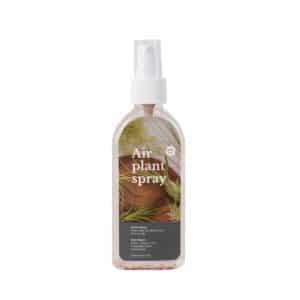
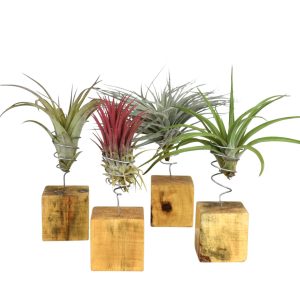


Welcome to our Tillandsia air plants category. Let’s start by explaining what air plants are and why they are such special, unique plants!
What are air plants?
Air plants are remarkable plants that do not grow in soil. Instead, they usually grow on other plants or use their few roots to cling to surfaces above the ground. They are ideal for hanging containers and make beautiful arrangements. Air plants do not need soil to grow! Instead, their leaves “feed” on moisture from the air and rain, taking in everything they need to thrive.
Tillandsia species are called air plants not because they can grow on air alone, but because they need no soil at all. In their natural habitat – the forests, mountains and deserts of South and Central America – they are epiphytes, growing on other plants without harming them and sprouting from tree branches. They are small and have no visible roots, and are mainly used to decorate interiors, as they need no pot or soil!
What are air plants used for?
Tillandsia air plants are grown as ornamental plants and are now a top choice for professional decorators, who use them to create gorgeous arrangements with shells, glass bowls and hanging elements.
Which air plants will you find in our shop?
In our shop you will find a range of air plants, each as striking as the next, such as tillandsia harissi, the tillandsia ionantha, the air plant Tillandsia butzii and more – so you can create your own arrangement to decorate your space just as you imagined!
Do air plants need sun?
To thrive, air plants need bright, indirect light. Rooms with south- or east-facing windows are ideal, as they get bright sunlight most days. North-facing rooms also work well, as long as the plant is close to the window and the light is not blocked by trees or buildings. Western light usually arrives late in the day and can be very hot and intense, so take care that your air plant does not dry out. As a general rule, the higher the humidity in your room, the more sun your air plant can take. So if you place it somewhere with plenty of light, mist it more often – twice a week or even daily! A sunny bathroom, for example, is an ideal spot, as the humidity from the shower will do most of the work!
Can I keep my air plant in a room without natural light?
You can keep your air plant in an office or basement room without natural light, but there are a few rules to follow to make sure it thrives.
Artificial light is essential for photosynthesis. Place your Tillandsia no more than 1 metre from the light source. If you use fluorescent light, the plants will need at least 12 hours a day.
How much water does an air plant need?
An air plant’s needs vary depending on where it is kept (temperature, sunlight, humidity and so on). You can water it by misting, soaking or a combination of both! Every one to two weeks, soak your air plant in room-temperature tap water for 5–10 minutes. Afterwards, shake it gently to remove excess water, turn it upside down and leave it on a towel in a bright spot. This is very important: air plants rot quickly if left sitting in water.
After soaking, the plant should be able to dry completely in less than 3 hours. If it is not drying quickly enough, move it somewhere brighter with more air circulation. Alternatively, once a week, mist your plant thoroughly so that its whole surface is moist (but not dripping).
The warmer and drier the air (summer and early autumn), the more you need to water. The cooler and more humid the air (winter and spring), the less water your air plant needs. Remember, though, that radiators and fireplaces dry out the air!
The best time to water your air plant is in the morning, as sun and air will help it dry. Soaking or misting in the evening disrupts the plant’s ability to breathe overnight and prolongs drying time.
Am I watering my air plant enough?
In fact, assuming that Tillandsia only needs air to survive is one of the most common mistakes we see.
If the leaf tips turn brown or dry out, it may be a sign that your plant needs more water!
On the other hand, if you overwater, you may not be able to save your air plant, so take care. If the base of the plant turns brown or black and the leaves fall off, it is probably rotting.
What is the ideal temperature for air plants?
Tillandsia air plants are not particularly sensitive to temperature. They are quite hardy but prefer 10–30°C, ideally with night-time temperatures about 10 degrees lower than daytime.
Do Tillandsia air plants need feeding?
Air plants are hardy and need little care. But to keep them vibrant and help them flower, you can add a little fertiliser, such as Fytopan for orchids, to the soaking water once or twice a month!
What is the life cycle of Tillandsia air plants?
Did you know that Tillandsia air plants flower only once in their lifetime? Depending on the species, the flowers last from a few days to several months and come in beautiful bright colours such as pink, red and purple. Flowering is the peak of the air plant’s life cycle, but it also marks the start of the plant’s decline, and after flowering it will eventually die.
But don’t despair! Shortly before, during or after flowering, depending on the species, your plant will reproduce by producing 2–8 baby air plants (pups). These pups start out very small but will eventually grow into mother plants themselves. They can safely be separated once they are about half the size of the original plant. Take care not to remove them too early, as they take important nutrients from the mother plant!