
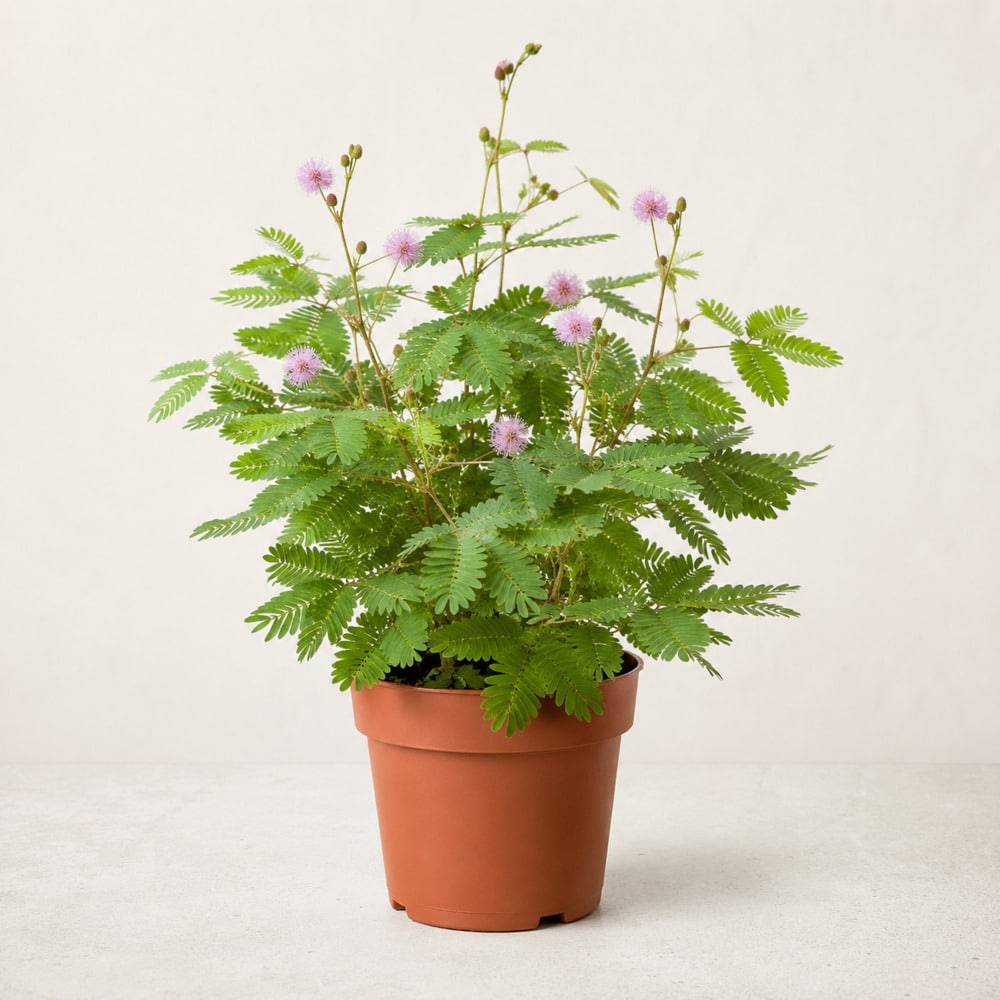

Mimosa Pudica (Sensitive Plant) in a Clay Pot
€12.90
Out of stock
Notify me when it's back in stock
Plant height: 13 cm
Pot diameter: 8 cm
Mimosa pudica is not just another green plant – it is a unique plant that shows us that plants can sense too! As you can see in our photo, the mimosa is a compact plant with green leaves and pink flowers. What sets it apart from almost every other plant in the world is that the moment it senses a touch, it folds up its leaves – even its small stems! It is a little marvel everyone should see up close and show their children. It makes a wonderful gift that is sure to impress!
An ideal gift for young and old alike, especially for anyone who has never seen this plant up close or didn't know it existed. The mimosa produces beautiful pink flowers and seeds on its stems, which are very easy to sow again.
What is Mimosa pudica?
Mimosa pudica is a moderately growing plant with small thorns on its stems, reaching 30 to 80 cm in height.
The mimosa (botanical name Mimosa pudica – “the shy mimosa”) is commonly known as the sensitive plant or touch-me-not, thanks to the remarkable way its leaves close and droop whenever something touches them!
Mimosa pudica is a striking example of how plants, like all living organisms, live, interact and respond in their own way! It is extremely sensitive to touch and reacts to stimuli such as touch, wind, water and loss of light by closing its leaves! In the United Kingdom it has received the Royal Horticultural Society’s Award of Garden Merit!
Train your own sensitive plant!
Many people say you can train your mimosa! For example, if you stroke it every day, it will learn that your touch poses no danger and will no longer need to close its leaves for you! This is said to have happened at Kew Gardens in England, where Mimosa pudica no longer treats the touch of thousands of visitors as a threat and keeps its leaves open!
Unlike carnivorous plants such as the Venus flytrap (Dionaea muscipula), Mimosa pudica closes its leaves for self-defence! This leaf-folding trick is an evolutionary survival mechanism developed over countless generations. Folding its leaves lets the mimosa respond quickly to potential danger in order to protect itself. However, while its leaves are closed, its ability to feed on light is reduced, so it cannot photosynthesise properly. A few minutes later, once the danger has passed, the leaves open up again!
How does the mimosa learn?
Mimosa pudica reacts to stimuli by closing its leaves to protect itself. It follows the same mechanism at night, when there is no sun to feed on, which also reduces water loss. But the mimosa can be trained! When something is repeated – daily watering, for example – the mimosa begins to recognise that it poses no immediate danger and stops reacting. In other words, it can become accustomed to repeated movements! The same can happen with a gentle stroke. So the mimosa learns, although nobody knows exactly how, since like all plants it has no brain or nervous system. There are many hypotheses, but none has yet gained scientific acceptance, and more research is needed to explain this fascinating ability to learn.
How soon can I have my own mimosa?
You can buy Mimosa pudica from our shop both as seeds and as a ready-grown plant. Mimosa pudica seeds take around 7 to 10 days to germinate, and in just 2-3 months you will have a well-developed plant! The mimosa produces beautiful pink flowers and seeds on its stems, which are very easy to sow again!
Where can I buy Mimosa pudica?
You can order your own Mimosa pudica plant on our website, or visit our shop at Psaron 14, Kalamata. Choose seeds to grow your own mimosa from scratch, or a ready-grown plant (see the plant height above)!
Watch the video below to see how Mimosa pudica reacts when its leaves are touched!
Does Mimosa pudica need special care or feeding?
You don't need to be an expert to grow your own mimosa! It is a fairly easy plant with no special requirements beyond sun and water. That said, to boost its growth you can use one of our fertilisers once a month, starting one month after planting.
Is Mimosa pudica an indoor or outdoor plant?
Mimosa pudica needs sun every day. It requires around 8 hours of daylight and tolerates full sun to partial shade. Because of its light and temperature needs, it is most often grown indoors as a houseplant. An average room temperature of around 16-30°C is ideal. It can also be grown outdoors, with a little extra care!
Where is the best place to put my mimosa?
Indoors, the ideal spot is right in front of or next to a bright, sunny window!
Why are my mimosa’s leaves closed?
Mimosa pudica closes its leaves at night, when there is no sun to feed on, and opens them again at dawn! If the leaves stay closed during the day, your mimosa is telling you it isn't getting enough light!
When should I water my mimosa?
The mimosa needs frequent watering to keep its soil moist. It tells you itself when it needs water: as soon as the top of the soil starts to dry out! But take care – the soil should stay consistently moist, yet water must never collect at the bottom of the pot, as this can lead to root rot!
Why are my mimosa’s leaves turning yellow?
As with most plants, yellowing leaves are often caused by overwatering! If your mimosa’s leaves are turning yellow and dropping, make sure there is no standing water in the pot, that it gets enough light and that it is kept somewhere warm, at 16-30°C.
Where does Mimosa pudica come from?
Mimosa pudica belongs to the legume family (Fabaceae), in the mimosa group, and is one of the few species of its genus grown as an ornamental. It is native to Central and South America, but today it is found in warm climates all over the world, including Bangladesh, Thailand, India, Nepal, Indonesia, Malaysia, the Philippines, Vietnam, Cambodia, Laos, Japan, Taiwan, Sri Lanka and Guam.
Mimosa pudica in traditional use
Mimosa pudica has been known since ancient times in India and many other parts of the world.
Researchers are studying the plant’s natural compounds.
Laboratory studies have also examined water extracts of Mimosa pudica roots for their activity against snake venom. This is early-stage research and should not be taken as a treatment.
What soil does Mimosa pudica need?
Mimosa pudica grows best in free-draining soil that is low in nutrients. It even seems to thrive in disturbed and eroded ground – in fact, poor soil usually helps it establish itself in an area. The mimosa dislikes shade and is sensitive to frost, which means it does not tolerate low light levels or very low temperatures.
How does Mimosa pudica move?
Mimosa pudica is famous for its rapid plant movement. Like many other plant species, it changes the position of its leaves in what is known as “sleep” or nyctinastic movement: its foliage closes in the dark and opens again in the light. This was first studied by the French scientist Jean-Jacques d’Ortous de Mairan. Because of its unique response to touch, the sensitive plant has become an ideal subject for many experiments on plant habituation and memory. Its leaves also close when stimulated in other ways – by touch, heat, blowing or shaking – through mechanical or electrical stimulation. These movements are known as seismonastic movements. This reflex may have evolved as a defence mechanism to deter grazing animals, or to shade the plant and reduce water loss through evaporation. Learning, then, is a tool that allows it to do exactly this: to draw on memory and a store of past experiences in order to change its behaviour in the future. In an era of climate change, the ability of living organisms to learn is more critical than ever, as environmental conditions are changing faster than before and posing more serious threats to life. Plants, for their part, have collectively survived many disasters caused by Homo sapiens, which means they may be even better learners than we are. Comparing an entire biological kingdom with a single species may seem odd, but it is a fair response to unchecked anthropocentrism, which places our own species above every other form of life on Earth.
Other properties of Mimosa pudica
Beyond its striking features, Mimosa pudica also has practical uses. This species has been shown to have excellent soil-cleaning properties.
In one study, thirty-six plant species were tested to see which was best at phytoremediation of soil contaminated with arsenic from tin mines. Mimosa pudica was one of four species that significantly extracted the pollutant and accumulated it in its leaves. Other studies have found that Mimosa pudica extracts heavy metals such as copper, lead, tin and zinc from contaminated soils, allowing the soil to gradually return to a less toxic state.
Mimosa pudica can form root nodules that are home to nitrogen-fixing bacteria. These bacteria convert atmospheric nitrogen, which plants cannot use, into a form that they can. This trait is common among plants of its family. Nitrogen is vital for both plant growth and reproduction, and it is also essential for photosynthesis, as it is a component of chlorophyll.
The mimosa’s ability to fix nitrogen may have arisen alongside the evolution of nitrogen-fixing bacteria. Nitrogen fixation is an adaptive trait that has turned a parasitic relationship between bacteria and plants into a mutually beneficial one. The changing dynamics of this relationship are shown by the matching improvement of various symbiotic traits in both Mimosa pudica and the bacteria.
How do I sow Mimosa pudica seeds?
Germinating mimosa seeds is quite easy! The seeds just need a little encouragement to sprout. Soak them in a glass of water for 24 hours. Then place them on the soil about 3 cm apart and cover them with roughly 1 cm of compost. Water regularly, keeping the soil moist at all times, and the seeds will germinate within a few days. Place the pot somewhere sunny, and in the winter months keep it indoors near a window where it gets sun.
Best sown in spring and summer, when there is more sunshine.


