One of the rarest trees you will ever come across! The beautiful baobab (Adansonia) is found mainly in Africa. Baobab populations are gradually declining, and these ancient trees are considered under threat. They are extremely tolerant of drought and high temperatures.
Here is your chance to own one of these unique trees and grow it just the way you like!
BAOBAB: “THE TREE OF LIFE”
The giant baobab tree, from the genus Adansonia, is found mainly in Africa, Australia and Madagascar.
It is one of the most beautiful and tallest trees on the planet, and truly unlike any other. It grows mainly in savannahs, deserts and scrubland, and some trees live for thousands of years, which is why they are regarded as ancient giants!
The genus Adansonia is named after the famous French botanist Michel Adanson, who studied and described the species in detail and called it “the most useful tree”.
The baobab is famous for both its great height and the enormous girth of its trunk. The trunk is often bottle-shaped and can reach up to 14 metres in diameter. It is fairly smooth and shiny, dark brown or grey in colour, with a cork-like bark, and its branches are wide compared with the rest of the tree.
The African baobab is distinctive for the way it grows, with many stems fused together and bark growing in the spaces between them.
It is difficult to tell the age of these trees, because as they grow older the growth rings in their trunks fade, making them hard to count.
All baobab species are deciduous and stay leafless for a long period – around eight months of the year. For the rest of the year, the tree is covered in huge, spectacular white flowers.
Common names: “upside-down tree” (its sparse branches look like roots) and “monkey-bread tree” (because of its edible fruit).
Baobab Species
There are nine different baobab species in the genus Adansonia.
Adansonia digitata (African baobab), Adansonia gregorii (Australian baobab), Adansonia grandidieri (Grandidier’s baobab), Adansonia rubrostipa (fony baobab), Adansonia kilima, Adansonia madagascariensis (Madagascar baobab), Adansonia suarezensis (Suarez baobab), Adansonia za and Adansonia perrieri (Perrier’s baobab).
What Is Baobab Used For?
Local people often use baobabs as shelters, as they can provide food, shelter, water and even clothing. The tree can store large amounts of water, which can be tapped during the harsh droughts that affect people and animals in these regions.
Baobab bark is also quite fire-resistant and can be used to make handmade clothing, baskets, cloth, hats and rope.
The Health Benefits of Baobab
Baobab is often called the “king of superfruits”, as it offers many benefits for the body.
Its leaves are tasty and a rich source of vitamin C, potassium, calcium and iron. They are used in traditional medicine and feature in many local diets. You can eat the leaves raw as a vegetable, or dry and powder them to enrich stews, soups and sauces, add them to drinks and smoothies, or even make homemade cereal bars.
Besides its leaves, baobab is famous for its fruit, which has a very hard, coconut-like shell filled with a white pulp. The fruit is considered an excellent source of vitamin C – reportedly even more than oranges – and is rich in antioxidants and low in fat.
Several studies suggest that baobab may also help support healthy blood sugar levels.
It has been known and used since ancient times.
Baobab fruit is high in fibre, which acts as a prebiotic and supports healthy digestion.
The seeds of the baobab fruit can also be pressed to produce a vegetable oil.
Baobab oil, although not yet well known in Greece, is rich in vitamins and highly beneficial. It deeply moisturises the skin and is said to support cell renewal thanks to its valuable nutrients. It is also used to help reduce wrinkles and to keep nails and hair healthy and shiny.
Buy a Baobab-Style Plant
You can buy an impressive baobab-style plant in a pot directly from our shop. At Flowerstore.gr we offer the Ansu Baobab (Adenium), also known as the desert rose, which looks just like a miniature version of the giant baobab trees. See it by clicking here.
Simply add the plant to your basket, go to checkout and it will be with you in no time.
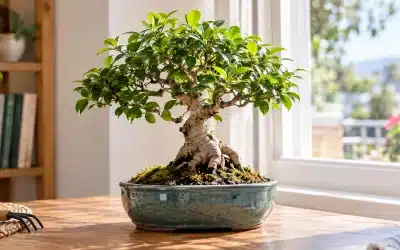
Some people even grow baobabs as bonsai, as you can see in the photo below!